Tag: mutual funds

Choices: Large-cap Investing

While looking at investing in large-cap stocks, investors have quite a few options available to them.

Mutual Funds

Previously, we discussed ‘Top 100’ funds — funds that invest in the largest market-cap stocks. This is one way to go about adding large-cap exposure to your portfolio. However, the expense ratios of more than 2% will eat into your returns. Remember, returns are not predictable, but fees are forever.

Passive ETFs

You can buy an equal proportion of the NIFTYBEES and the JUNIORBEES ETFs. Since these are exchange traded, you don’t have to go through the hassle of “surrendering” your mutual fund “units” and keeping track of exit-loads etc. Besides, NIFTYBEES’ expense ratio is 0.5% and JUNIORBEES’ 1%. Overall, you pay 0.75% to Goldman Sachs to manage the ETFs.

Not a bad deal, considering that you end up tracking the CNX 100 index which represents the top 100 stocks by market cap.

Active ETFs

We have a Theme that takes a tactical route when it comes to tracking the CNX 100 index. Its called the CNX 100 50-Day Tactical Theme. The basic idea is to switch between (NIFTYBEES + JUNIORBEES) and LIQUIDBEES depending on whether the CNX 100 index is trading above or below its 50-day moving average. Details of the strategy can be found here.

The drawback is that in flat markets, you end up getting whipsawed a lot. But if you have the discipline to stick with it for over 5-years, it has the ability to deliver superior risk-adjusted returns.

Conclusion

Each of the approaches described above have their advantages and disadvantages. With mutual funds, you have a brand-name manager who is working for you. With the passive route, you save on fees. The tactical route will probably lessen drawdowns during a market crash and preserve capital.

What you end up investing in finally boils down to whatever sails your boat.

Comparison: Top 100 Funds

Large-cap stocks

Large-cap stocks are less volatile, ceterus paribus, compared to mid-cap and small-cap stocks. For most first-time investors, the set of Top 100 Funds offers a straight-forward way of adding equity exposure.

Fund/Scheme IRR (2014) Expense
Birla Sun Life Top 100 Fund -Growth Option 48.27% 2.82%
ICICI Prudential Top 100 Fund – Regular Plan – Growth 37.71% 2.77%
IDBI India Top 100 Equity Fund Growth 40.05% 2.87%
UTI – TOP 100 Fund- Growth Option 40.68% 2.43%

Picking the right scheme

Birla Sun Life Top 100 Fund -Growth Option.performance

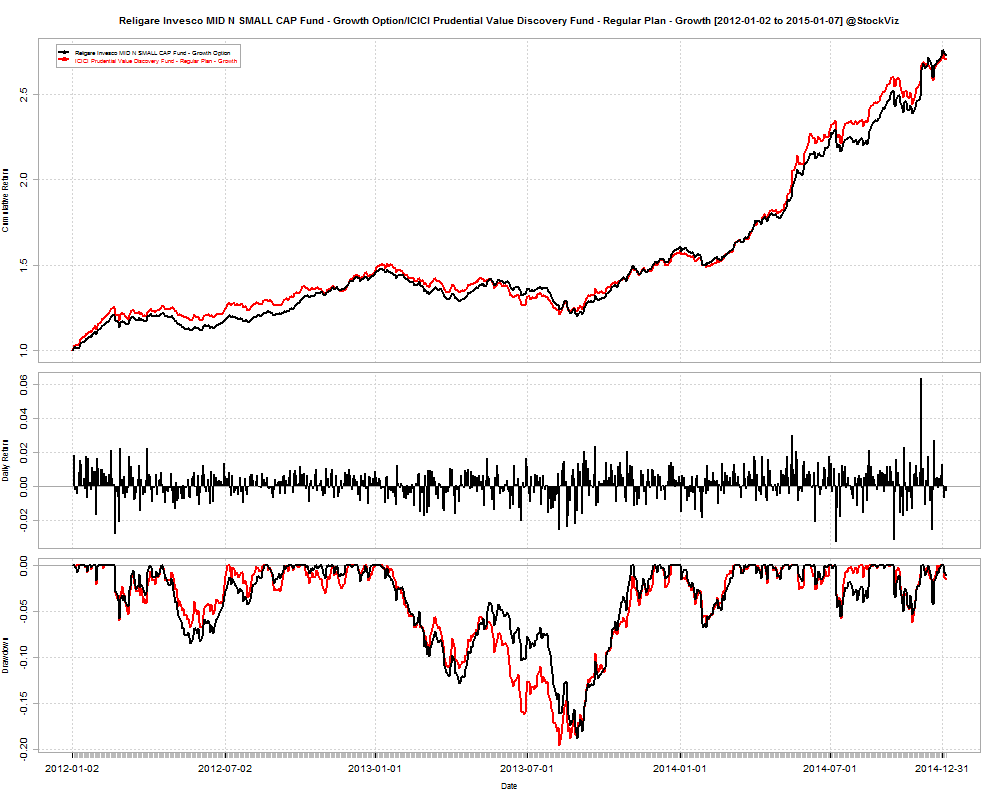
As an investor, you should care about two things: risk-adjusted returns and expenses. While the Birla fund gave better returns, it charged a higher fee compared to UTI. But are those higher returns sustainable? Investors should be willing to pay more for more. This is where the FundCompare tool can help.

Birla vs. UTI

Birla vs. UTI Top 100

Between 2009-07-01 and 2014-12-29, Birla Sun Life Top 100 Fund (Growth Option) has returned a cumulative 155.00% with an IRR of 18.56% vs. UTI TOP 100 Fund (Growth Option)’s cumulative return of 108.35% and an IRR of 14.28%.

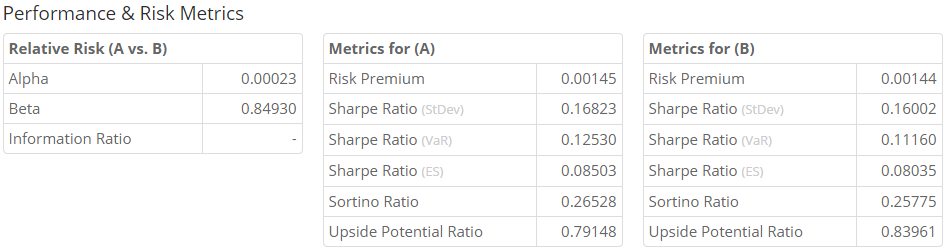
On the face of it, Birla’s higher fees seems worth it. But it looks like higher returns came at the expense of higher risk. Birla’s beta (vs. CNX 100) is 0.90761 vs. UTI’s 0.83478 and the latter had deeper drawdowns as well. However, the Sortino Ratio tilts the scale towards Birla’s fund: 0.10762 vs. UTI’s 0.09043.

Conclusion

If you are looking for large-cap exposure then go for Birla Sun Life Top 100 Fund.

FundCompare: Pruning your Mutual Fund portfolio

The dilemma

Ownership of a diversified, un-correlated set of assets remains the touchstone of a well crafted portfolio. We had discussed how adding bonds to your equity portfolio reduces volatility before. However, comparing correlations between funds within the same asset class is a challenge.

For example, say you already have the Reliance Equity Opportunities Fund in your portfolio and your agent is pitching the Sundaram Select Midcap fund, how do you figure out whether to add to your existing holding of the Reliance fund, add an extra line item or switch to Sundaram?

Comparative returns

reliance_sund_returns

Between 2006-04-03 and 2014-12-19, Reliance’s Fund returned a cumulative 280.08% with an IRR of 16.55% vs. Sundaram’s cumulative return of 290.44% and an IRR of 16.91%.

As you can see, the wealth charts are almost on top of each other. The correlation chart confirms it:

reliance sund cor

Except for a few outliers, they are almost the same fund packaged differently.

Histogram of returns

The FundCompare tool also gives you the histogram of fund returns and the associated skewness. In this case, the Reliance Fund has a skew of -0.15 vs. Sundaram’s +0.22. Given that the average returns are more-or-less the same, this means that Sundaram’s Fund is better. Besides, it also appears that Sundaram’s Fund has a better Sharpe ratio.

Given that Reliance’s Fund has an expense ratio of 2.29% vs. Sundaram’s 2.26%, I would say “switch.”

Compare Your Funds

Before pulling the trigger based on what your fund broker/adviser tells you, get a free quantitative analysis of your options on our FundCompare tool.

Are we setup up for a bond rally?

ICICI came out with an interesting note on why they expects Indian bonds to rally. They outline 5 factors:

  1. Improving current account balance
  2. Falling inflation
  3. Fiscal consolidation
  4. Rising savings rate
  5. Substantial FII inflows

Related: Long-term Gilt Funds, where we layout the same thesis.


You can run our comparison tool here: FundCompare


Please get in touch with Shyam for advice on investing in mutual funds.
You can either WhatsApp him or call him at 080-2665-0232.
He is an AMFI registered IFA who can advice you on IDBI, Mirae, HDFC, ICICI Pru, UTI and Birla Sun Life funds.

Broken Funds

Cycles usually turn and the most hated sectors end up bouncing back and out-performing the broader markets. Does the same apply to actively managed mutual funds? Should you bet on the asset manager’s luck turning and getting off to the races? Here are some “broken” funds that maybe of interest.

Escorts Infrastructure Fund

Since 2007-09-21, Escorts Infrastructure Fund has returned a cumulative -38.19% vs. CNX 500’s +58.39%. This fund should get a bad-timing award, having launched in 26-Jul-2007, if MorningStar is to be believed (factsheet.) If you are bullish on Indian infrastructure, you may be better off buying the INFRABEES ETF. [stockquote]INFRABEES[/stockquote]

JM Equity Fund

I wonder what the holdings of this fund were in 2008? It lost -71.81% (CNX 500: -64.26%) in value during the crash and is yet to recover. Seeing how well it tracked the broader market, it might make sense to just hold a CNX 500 index fund instead of paying this manager to actively run your investment to the ground.

JM Basic Fund

Since 2006-04-03, JM Basic Fund has returned a cumulative 4.72% vs. CNX 500’s cumulative return of 117.04%.

jm basic fund

Looks like the fund blew up pretty much every year of its existence.

HSBC Progressive Themes Fund

Something happened in Oct-2010 that permanently changed the course of this fund.

Since 2006-04-03, HSBC Progressive Themes Fund has returned a cumulative 36.18% vs. CNX 500’s cumulative return of 117.04%. And since 2013-01-01, the number is 25.73% vs. 31.98%.

Progressively losing client’s money.

Taurus Bonanza Fund

This fund was a bonanza for the asset manager who continues to charge 2.83% on Rs. 250.8M of assets (MorningStar.) Since 2006-04-03, Taurus Bonanza Fund has returned a cumulative 51.66% vs. CNX 500’s cumulative return of 117.04%.

It is yet to recover from the 2008 crash and you are probably better off buying a CNX 100 or CNX 500 index fund instead of chasing this bonanza.

Conclusion

It is said that there is a lot you can learn from studying failure. By looking at the track records of these broken funds, I think the key take-away here is that buy-and-hold only works if you (a) understand what it is that you are holding, and (b) stick to a strict re-balance frequency. Moreover, betting on reversion to mean might only work if you are betting that an out-performing manager will fall back to mediocrity. The other direction is a tough ask.

You can run the comparison tool here: FundCompare


Please get in touch with Shyam for advice on investing in mutual funds.
You can either WhatsApp him or call him at 080-2665-0232.
He is an AMFI registered IFA who can advice you on Mirae, HDFC, ICICI Pru, UTI and Birla Sun Life funds.