Tag: mutual funds

Mutual Fund Performance in Bear Markets

Introduction

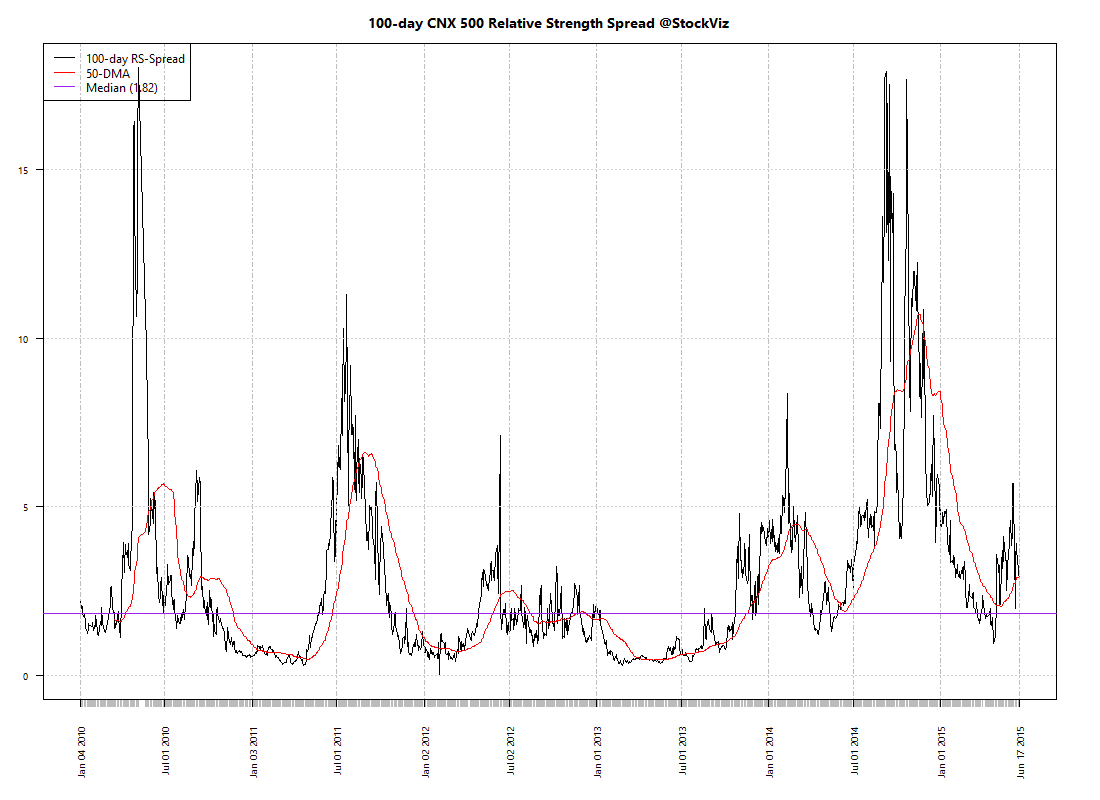
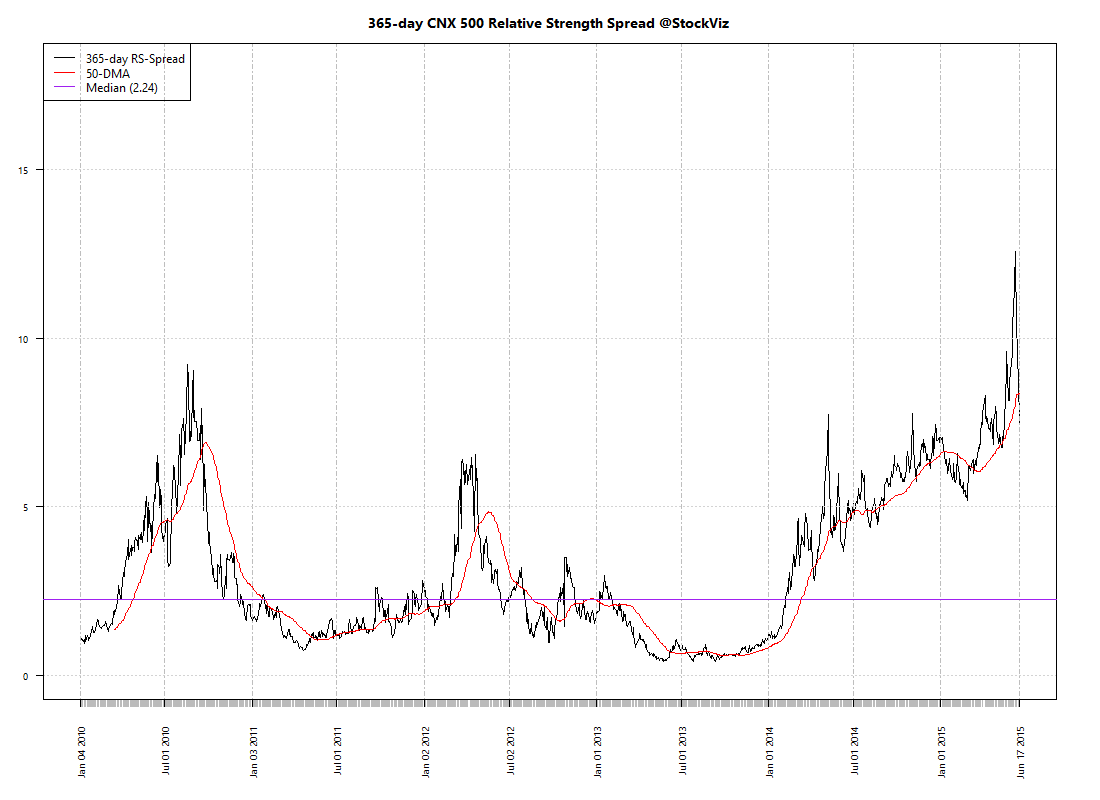
During our discussion on Relative Strength Spread, we saw how the relative performance between winners and losers were compressed in the bear markets of 2011, 2012 and 2013. During these doldrums, most active investment strategies fail to outperform their benchmarks. Since most mutual fund investments span multiple bull and bear markets, it makes sense to have a look at how funds performed in the most recent bear market.

For our analysis, we took funds that had more than 90% allocated in equities and ignored sector and international funds. We then applied the same benchmark, the CNX Midcap Index, to make sure that we had an apples-to-apples comparison. A total of 200 funds were analyzed.

The 10 worst funds

Information Ratio

Sharpe Ratio

Beta

Bear Beta

Draw down depth

Draw down length

The 10 best funds

Information Ratio

Sharpe Ratio

Beta

Bear Beta

Draw down depth

Draw down length

Conclusion

The Birla MNC fund stands out as one having the most points in its favour: low and shallow drawdown, better sharpe and higher returns. The next stand outs were the Axis Long-term equity fund and the Mirae Asset Emerging Bluechip Fund.

In terms of the worst funds, HSBC Progressive Themes was definitely regressive to your wealth. JM Basic and Sundram SMILE funds also laid a deuce.

Mutual funds are marketed as wealth builders. However, the truth is that most of them struggle. At last count, there were more than 5300 different schemes that you could choose from.

Are you getting the right advise? Get in touch with us if you are looking to invest! Call us or Whatsapp us at +918026650232

The Problem with Balanced Funds

Returns vs. Volatility

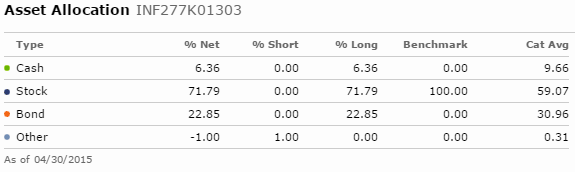
Balanced funds are those that invest in both stocks and bonds. The exact allocation is up to the fund manager. For example, the Tata Balanced fund is right now 22.85% in bonds and the rest in equities, according to Morningstar.

tata balanced asset allocation

Balanced funds are pitched as having lesser risk than equity-only funds. But what investors gain in lesser volatility, they give up on lower returns and higher fees.

Tata Balanced vs. ICICI Pru. Value Discovery

Between 2007-01-02 and 2015-06-02, Tata Balanced Fund has returned a cumulative 235.97% with an IRR of 15.48% vs. ICICI Prudential Value Discovery Fund’s cumulative return of 316.55% and an IRR of 18.47%download

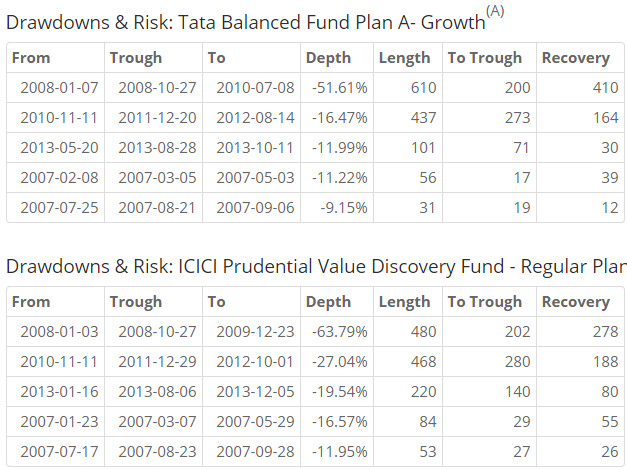
Compare the drawdowns:

drawdowns tatas vs icici

For the moderate-risk taking investor who is typically attracted to balanced funds, a 16% drawdown hurts just as much as a 27% drawdown.

When it comes to fees, Tata’s has an expense ratio of 2.91% vs. ICICI’s 2.34%. Is the extra 50bps worth the safety offered?

HDFC Balanced Fund vs. ICICI Pru. Value Discovery

It is a similar deal with HDFC’s Balanced fund as well: lower returns (IRR: 15.24%) and no escape from double-digit drawdownsdownload

Conclusion

The sales-pitch for balanced funds focus on the investors availability heuristic where people tend to heavily weigh their judgments toward more recent information, making new opinions biased toward that latest news. Ever since the market corrected in March a growing flock of blogs and articles started pitching balanced funds. But before you fall for the marketing pitch, take a step back and ensure that you are not giving too much away for perceived safety.

The Worst Mutual Funds – Quantitative

Introduction

Our previous post looked at the 10 best mutual funds based on sharpe ratio, bear-beta, information ratio, draw-down depth and draw-down length between Jan-2010 and May-2015. Here are the 10 worst funds based on the same metrics.

As you can imagine, infrastructure funds performed poorly in this time-frame. We ignore them for now.

Sharpe Ratio

Bear-Beta

Information Ratio

Draw-down Depth

Draw-down Length

Past Performance

Conclusion

Mutual funds are marketed as wealth builders. However, the truth is that most of them struggle. As you can see from the analysis here, there are quite a few of them with low-single-digit returns over 5-year time-frames. At last count, there were more than 5300 different schemes that you could choose from.

Are you getting the right advise? Get in touch with us if you are looking to invest! Call us or Whatsapp us at +918026650232

The Best Mutual Funds – Quantitative

Introduction

Mutual fund investors are faced with a zillion choices in the marketplace. At last count, there were more than 5300 different schemes that an investor could choose from. When confronted with such a large number of choices, investors either spiral into an “analysis paralysis” mode and end up doing nothing or blindly invest in whatever their broker recommends – both these paths lead to situations that are injurious to the investor’s long-term financial health.

In this post, we try to simplify the choices in front of the investor by ranking the top 10 funds based these risk metrics: sharpe ratio, bear-beta, information ratio, draw-down depth and draw-down length between Jan-2010 and May-2015.

Sharpe Ratio

Bear-Beta

Information Ratio

The information ratio is a ratio of the portfolio’s returns above the returns of a benchmark (CNX MIDCAP, in this case) to the volatility of those returns.

This is probably a better metric than the Sharpe ratio to rank funds.

Nice to see that both the Value Discovery fund and an MNC fund make this list.

Draw-down Depth

Draw-down depth measures the max-loss from peak valuation.

For example, the Blended Plan at the top of the list only lost 0.35% from its peak valuation between 2010 and 2015.

Portfolios with a lot of short-term bonds test well for this metric. But note the pathetic IRRs – no pain = no gain!

Draw-down Length

The draw-down length is a measure of how many days it took the fund to get back the previous peak valuation after a draw-down.

Shorter bounce-backs typically indicate high-quality portfolios.

Nice to see both the MNC funds make this list.

Past Performance

Conclusion

We looked at broad spectrum of funds – including those with bond allocations – to ferret out a good set of funds that investors can consider. Depending on what is more important to the investor, the appropriate set of metrics can be weighted to fit individual risk appetites.

Mutual fund investors whom we advise will immediately recognize some of these funds as they are already part of their portfolios. Get in touch with us if you are looking to invest! Call us or Whatsapp us at +918026650232

The MNC Fund Gravy Train

What are MNC Funds?

MNC funds invest in the Indian listed shares of foreign firms, like Bosch, Britannia and Colgate Palmolive. The funds are bench-marked against the CNX MNC Index.

The MNC index has out-performed pretty much every other market-cap index. We had discussed this previously and had pointed out that the UTI MNC Fund is decent place to get exposure to this asset class.

UTI vs Birla Sun Life

Thankfully, there are only two funds that track this asset class – one is the UTI MNC Fund and the other is the Birla Sun Life MNC Fund. Here’s how their growth schemes compare:

Birla Sun Life MNC fund vs. UTI MNC fund


Between 2006-07-03 and 2015-03-19, BSL MNC Fundhas returned a cumulative 478.61% with an IRR of 22.31% vs. UTI MNC Fund’s cumulative return of 427.17% and an IRR of 21.02%. (http://svz.bz/1Exk126)

The difference in performance between the two funds is de minimis when you consider that the period of comparison is almost eight years. The main thing to focus on here is that an IRR of ~22% is extremely hard to achieve in any asset class over that stretch of time.

MNC.funds.2015-3-20

Active Management

SYMBOL Birla Sunlife MNC Fund UTI MNC Fund CNX MNC
INGVYSYABK 8.97 3.01
ICRA 8.67
HONAUT 8.53 3.48
BAYERCROP 8.33
BOSCHLTD 5.99 7.19 9.22
GILLETTE 5.89 2.71
GLAXO 5.48 1.44 2.59
PFIZER 5.15 1.38
MARUTI 3.62 7.16 18.09
STERLINH 3.61
CRISIL 3.01 2.92
HINDUNILVR 2.74 4.21 24.37
CUMMINSIND 2.73 4.36 4.38
WABCOINDIA 2.47 0.32
ACC 1.96
BATAINDIA 1.65
HITACHIHOM 1.64
FAGBEARING 1.47
KANSAINER 1.45
COLPAL 1.39 1.33 5.02
PGHH 1.35 1.92
OFSS 1.15 2.43 2.62
SMLISUZU 1.15 0.12
AMBUJACEM 1.11 3.64 7.25
NESTLEIND 0.94 1.38
ALSTOMT&D 0.72 1.76
BLUEDART 0.71 0.58
SIEMENS 0.7 3.04 4.66
FMGOETZE 0.69
ITC 0.66
AIL 0.59 0.17
DISAQ 0.57
AKZOINDIA 0.53 1.6
FULFORD 0.52
ABB 0.49 2.51
SANOFI 0.46 1.41
ITDCEM 0.46 2.31
CASTROLIND 0.45 2.97 2.59
RANBAXY 0.36 0.58
SCHNEIDER 0.26
MPHASIS 0.07 2.33 1.2
EICHERMOT 6.28
BRITANNIA 4.17 4.84
MCDOWELL-N 2.53
SKFINDIA 2.47
MAHINDCIE 2.13
SSLT 1.95 7.96
INGERRAND 1.49
MONSANTO 1.13
TIMKEN 1.07
CLNINDIA 0.97
GSKCONS 0.9 2.69
AUTOAXLES 0.38
WHIRLPOOL 0.21
Both funds are actively managed. There is no “index-hugging” going on here. However, between the two, the Birla Sunlife fund significantly differs from the CNX MNC index.

Portfolio trajectories

Both have allowed their winners to run and have different positions that have worked out well for them. Here’s how the Birla Sunlife Fund looks like:

And this is how the UTI Fund looks like:

The View

You will do well to have either fund in your portfolio. But given the narrow focus of these funds, these should complement your portfolio rather than dominate it. If you have any questions, feel free to get in touch!