The standard deviation over 200-days and future 20-day returns from 2010 through 2015 of NIFTY MIDCAP150 MOMENTUM 50 TR and NIFTY200 MOMENTUM 30 TR looks like this:
Can historical volatility, as measured by standard deviation, be used to enter and exit momentum strategies?
On a rolling basis, there doesn’t seem to be a strong correlation between historical volatility and future returns. Back-tests over this period might give you a config that might look like it works but it is probably a fluke.
Given that liquid ETFs for these indices are not available and we are stuck with index funds for the foreseeable future, we setup a back-test to calculate the 200-day std. dev. at the end of each month to decide whether to hold it for the next month. Needless to say, the results were pretty lackluster.
We chose the 2010-2015 period because it avoids the 2008 crash and the subsequent recovery. The back-tests look phenomenal when you include that data but we wanted to see how such a strategy would perform in “normal” markets before stress-testing it. We don’t want to be the generals always fighting the last war.
We’ve been having a bit of fun with the S&P Sector “Spider” ETFs: Intro, Momentum, Anti-Momentum. We saw how strategies that backtested well with pre-2011 data failed later. In this post, we see if buying all ETFs with a positive return over n-months help us beat the S&P 500 index.
Calculate rolling returns over n months. Where n = 1, 3, 6, 12.
For the n+1th month, go long the ETFs that had positive returns in Step 1.
Like before, we split the dataset into Before 2010 and After 2011.
Pick your Fighter
The Before 2010 dataset shows rotation by 6- and 12-month look-back periods to be better than buying-and-holding the S&P 500.
The SPY Rope-a-Dope
MOM6 and MOM12 were too close to call in the training set. If you had “course-corrected” after the first couple of years of under-performance of MOM12 and switched to MOM6, you would’ve out-performed. On the other hand, staying the course would’ve meant losing out to the mighty S&P 500.
Once again, by simply holding onto the ropes, a passive buy-and-hold S&P 500 investor would’ve come out miles ahead of someone who tried to time sectors systematically.
What did we learn?
We tested a few basic allocation strategies that investors typically use to approach the “rotation” problem. Some of them worked well in the training set but their performance failed to carry over. Besides, if you add transaction costs and taxes, we are not sure if it was worth the effort given the post-2011 market regime.
Maybe there are more sophisticated qualitative/fundamental ways to approach this problem that work. However, most media articles about “sector rotation” are written with perfect hindsight and it is near impossible to do it with simple strategies that are accessible to the average investor.
Previously, we saw how buying the best performing sector and holding it for a month didn’t quite pan out. What if, we bought the worst performing sector instead? The “Dogs of Sector Spiders,” if you will.
Calculate rolling returns over n months. Where n = 1, 3, 6, 12.
For the n+1th month, go long the ETF that had the lowest return in Step 1.
Like before, we split the dataset into Before 2010 and After 2011.
Pick your Fighter
The Before 2010 dataset shows rotation by 3- and 6-month look-back periods to be better than buying-and-holding the S&P 500.
The 6-month look-back rotation strategy – MOM6 – would’ve been the strategy to bet on.
The SPY Rope-a-Dope
“Sure-things” don’t exist in finance.
MOM6 spent the last decade getting absolutely decimated by the S&P 500.
Once again, by simply holding onto the ropes, a passive buy-and-hold S&P 500 investor would’ve come out miles ahead of someone who employed this rotation strategy.
While introducing S&P 500 sector ETFs, we showed how the cross-correlations between them were unstable. This makes developing simple strategies challenging. One common momentum strategy is to simply go long whatever worked best in the previous period.
Rules of Rotation
For ETFs: XLY, XLP, XLE, XLF, XLV, XLI, XLB, XLK, XLU, and SPY
Calculate rolling returns over n months. Where n = 1, 3, 6, 12.
For the n+1th month, go long the ETF that had the highest return in Step 1.
In Step 2, if the selected ETF has -ve returns, stay in cash and earn zero.
We split the dataset into Before 2010 and After 2011.
Pick your Fighter
The Before 2010 dataset shows rotation by all look-back periods to be better than buying-and-holding the S&P 500.
Probably because of the prolonged dislocation caused by the GFC in 2008 and 2009, all rotation strategies based on the rules above exhibited great stats.
The 6-month look-back rotation strategy – MOM6 – gave an annualized return of 13.04% vs. S&P 500’s 1.19%. Coming out of the crisis, this would have been the fighter to bet on.
The SPY Rope-a-Dope
In boxing parlance, a “Rope-a-Dope” is
When you maintain a defensive posture on the ropes in an attempt to outlast or tire your opponent. It is most recognized and was actually given that name by Muhammad Ali when he employed the technique to defeat George Foreman.
The After 2011 dataset is a prime exhibit of why “sure-things” don’t exist in finance.
The S&P 500 spent the next decade demolishing everything.
MOM6, the winner from our first round, went on to underperform the S&P 500 for the next 10 years by ~4%
By simply holding onto the ropes, a passive buy-and-hold S&P 500 investor would’ve come out miles ahead of someone who employed this rotation strategy.
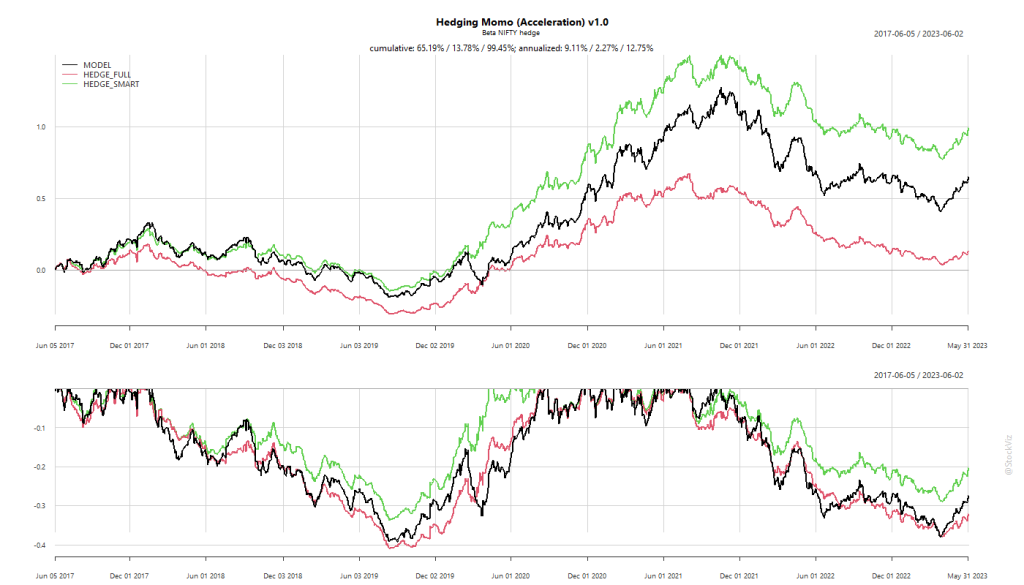
Momentum investing strategies have historically produced high returns in Indian equities. The biggest problem with them has been deep drawdowns when the markets enter bear territory.
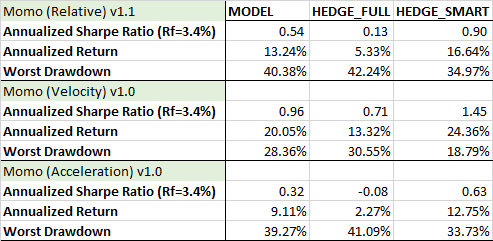
A number of risk management strategies like using moving averages, trailing stop-losses, and hedging have been discussed on this blog before. These strategies, either standalone or in combination with each other, have provided investors with significant protection against momentum crashes. These are “exogenous” techniques, i.e. they are not part of the strategy itself but is imposed by portfolio management infrastructure. The advantage of these techniques is that the default is to be always invested in the market. It is risk-management’s job to control exposure.
Alternatively, endogenous risk-management techniques are those that are baked into the investment strategy itself. Our All Star strategy is a prime example of a momentum strategy that reduces exposure to equities by design. If enough stocks are not hitting their all-time-highs, it simply sits in cash. When you combine this with one of the exogenous risk-management techniques, you end up with a high Sharpe portfolio.
The advantage of high Sharpe strategies is that you can use leverage to amplify returns. However, if you are a “cash-and-carry” investor then it might be too conservative. Is there a momentum strategy that sits between All Star and traditional momentum?
High-to-Price (HTP) Momentum
A new paper, Büsing, Pascal and Mohrschladt, Hannes and Siedhoff, Susanne, Decomposing Momentum: Eliminating its Crash Component (SSRN,) outlines a new way to slice the 52-week momentum strategy to avoid crash risk. It describes a ranking system based on High-to-Price (HTP) where HTP = ln(Phigh/P0) where Phigh is the stock’s 52-week high price and P0 is its price at the beginning of the period.
A monthly rebalanced HTP long-only portfolio looks promising. It sidestepped quite a few whipsaws and has a better drawdown profile than NIFTY 50.
There have been periods where the strategy couldn’t find 25 stocks to go long and it only had a handful of positions or was all cash. However, the degree of overlap between constituents in consequent months is quite high indicating that the portfolio is likely to experience very low churn. In this aspect, it is very similar to the All Stars strategy.
At a line-item level, there have been instances where some stocks have tanked more than 30% in the month. However, the skew is, by-and-large, positive.
Investing in HTP Momentum
The real world doesn’t line-up perfectly to match the end-of-the-month rebalancing activity outlined in our backtest. To make this strategy investible, it needs to have some risk-management strategy in place on a clearly defined universe of stocks and has to be dynamically rebalanced.
We present our High-to-Price (HTP) Momentum Theme that consists of a portfolio of 25 stocks selected from the top 300 stocks by market-cap that rank high on their HTP scores. A 10% trailing stop-loss ensures that errant positions don’t drag down the whole portfolio. It is ideal for investors who can accept a bit more risk than All Stars for potentially higher returns.