Tag: crypto

Strategy 9 with Crypto

When we ran Carver’s Strategy 9 with 15 Instruments, we noticed how most of the returns were driven by crypto. However, that had only the three big coins – BTC, ETF and SOL. Since hand selecting instruments to trend-follow is also a form of overfitting, we expanded the universe to include all x-USDT coins listed in Binance since before the year 2019. There are 21 of those.

Once you expand the universe, the sheen wears off.

While the highest returns came from using a Binary Long-Only Equal-weight strategy, it came with a 60% drawdown, ruling out leverage.

Digging into the coin-level metrics, we see how a fair number of coins have negative contributions.

While the Big 3 coins had favorable trend-following returns, expanding the universe did not yield a better portfolio.

Code and charts on github.

Strategy 9 with 15 Instruments

Our previous post on Rob Carver’s Strategy 9 experimented with four major Indian indices. We saw that only two of them contributed to out-performance while the others dragged.

Can we just run those that worked and throw away the rest?

The whole point of using multiple moving averages is to avoid overfitting. Hand selecting instruments to trend-follow is also a form of overfitting. Carver repeatedly says that his approach works best on a large set of instruments (start with 100 and whittle down.) However, as an Indian retail trader, we do not have many options. Realistically, we can lay our hands on at most 15 different instruments.

With these 15, we played around with: scaled vs. binary x long-only vs. long-short x equal-weighted vs. inverse volatility weighted.

The results are sobering.

Long-only Equal-weight

Long-short Equal-weight

Long-only Inverse-volatility-weighting

Long-short Inverse-volatility-weighting

Of these, only the scaled long-only equal-weight setup looks promising. However, if you look at how individual instruments performed, it is hard to remain unbiased.

The largest contributor is crypto.

Charts and code are up on github (equal-weight, inverse-volatility-weight)

Getting Bullish on Crypto

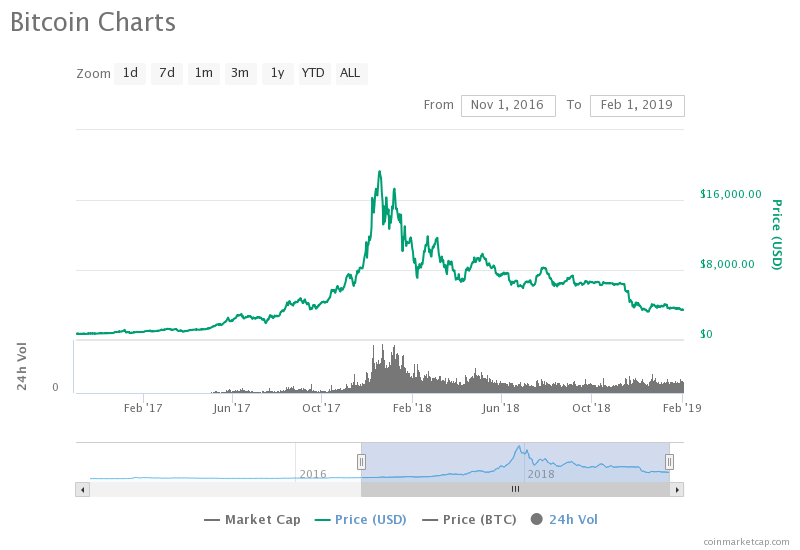
Jan 2018 was the height of crypto-fever. Every punter I knew was “trading” it. Then came crypto-winter. Then the RBI banned banks from doing business with any entity dealing with cryptos. And now we are going through a new phase: crypto-indifference.

Bitcoin was hailed as “digital gold.” And crypto’s were supposed to supplant fiat currency (aka, regular currency) as a store of value and a medium of exchange. Never going to happen. And that is a good thing.

I had talked quite a few of our investors out of “investing” into cryptos last year. And it proved to be a good call. Now is the time to have a re-look.

Will crypto’s ever be a store of value or a medium of exchange or an alternative to fiat currency? No. But they don’t need to be any of those to be useful. There are a lot of use-cases where a “score” needs to be kept within a closed network. Situations like voting within your apartment complex or splitting bills with your roommates or friends. There are micro-payment use-cases where you don’t need to have a charge-back facility. I see the core ideas behind the crypto+blockchain toolset being embedded in applications that a network would use everyday. And there is sufficient plumbing available now to do these experiments faster.

It is still an open question as to who and how these will be monetized. But now that the punters have pretty much written off cryptos, it allows the space to step back and innovate without the distractions of a ticker-tape.

Does this mean that you should go out and buy a bunch of bitcoin? No! I remain bearish on the price of all cryptos, including bitcoin. But I am now bullish on their value.

The Dao of Collusive Trading

When people talk about crypto-currencies, the primary focus so far has been the price of bitcoin, ethereum, etc. However, that is only scratching the surface of what is possible. When you dig a little deeper, you find yourself sucked into a rabbit-hole. One such rabbit-hole is the DAO.

Decentralized Autonomous Organizations

DAO stands for Decentralized Autonomous Organization. A traditional corporation is structured in a top-down hierarchy where decisions are taken by CxOs and handed over to people down the hierarchy to execute. But what if you replace CxOs and workers by code and replace the decisions making mechanism by votes? You get a DAO.

In a DAO, participants buy DAO tokens and vote on what tasks need to be performed. The set of tasks is defined in code. The DAO then uses “smart contracts” to perform those tasks. As long as the output can be digitally verified, the whole thing can be distributed (does not need a central server) and anonymous.

The ability to anonymously create and participate in a DAO could open up a whole can of worms when it comes to securities market regulation. Take synchronized and circular trading, as an example for collusive trading.

Synchronized and Circular Trading

A synchronised trade is a transaction where the buy and sell orders are identical, and are put through at exactly the same time on a stock exchange. A circular trade is where a set of brokers buy and sell shares frequently amongst themselves. The intention could either be to artificially influence price, trading volume or tax avoidance.

Surveillance systems red flag these transactions and SEBI follows up by proving collusion and intent. The latter is possible because there is always a paper-trail and it is possible to draw a relationship diagram between market participants under the lens. But a DAO can upend that.

The DAO can be setup anonymously. The crypto that is required by the DAO can be acquired and traded anonymously. Participants can vote on the stock to be manipulated anonymously. The DAO can execute the code (“smart contract”) that trades these stocks autonomously.

So even if a surveillance system red flags these transactions, it becomes next to impossible to prove collusion. The trades would occur between participants who have not even interacted with each other before – just like what occurs naturally in a stock exchange.

Please tell me that some version of this is not possible.

Links:
DAOs, DACs, DAs and More: An Incomplete Terminology Guide
DACs VS the Corporation
What is a DAO?
How Do Ethereum Smart Contracts Work?