Top 5 Investing Mistakes

1903 stock certificate of the Baltimore and Oh...

Image via Wikipedia

I missed the rally in TATAMOTORS today. When a stock that you don’t own takes off (+11% since yesterday), you are filled with blinding rage. I made the #1 mistake of letting my individual preference interfere with my investment decision. I never liked Tata cars – I feel that they fall apart in a year and their interiors are sub-par. But turns out I missed the wood for the trees. So I sat down and wrote up a list of 5 mistakes that investors should avoid:

  1. Getting confused between the company’s product and its stock. Very often, you may love the product the company makes. You may love the XUV 500, but that’s not a good reason in itself to own M&M. You may hate Airtel’s service, but that’s not a good reason in itself not to own BHARTIARTL.
  2. Getting caught up in a fad without thinking through the economics. The market goes through periods where everybody is talking up one sector. I have seen infatuation with infrastructure stocks, real estate, FMCG, oil & gas all come and go. The only thing that is guaranteed with infatuation is a nasty hangover. Don’t only focus on the sector du jour. Focus on revenue growth, profitability and valuation of companies across sectors.
  3. Hanging on to your losers. We all make mistakes. But hoping for a miracle that will somehow turn a position that is down 10% is stupidity. You should have a stop-loss, or better yet, a trailing stop. Let the losers go.
  4. Letting go of your winners. This is the corollary to #3. Why sell a stock that’s on a hot streak. Own it till the rally exhausts itself. If you have a trailing stop setup, the exit automatically takes care of itself.
  5. Getting confused between trading and investing. My sincerest advice is to leave intra-day trading to computers. High Frequency Trading (HFT) has pretty much taken over most exchanges in the world, driving down holding periods to seconds (on an average, the holding period of a stock in the US is around 22 seconds.) You cannot compete with the machines. Your “short term” should at least be a month. This allows you to do your homework and focus on the total return of your portfolio.

And for those who owned TATAMOTORS before the results, good job!

Questions? Email me: abhi@stockviz.biz

The Dividend Announcers Club

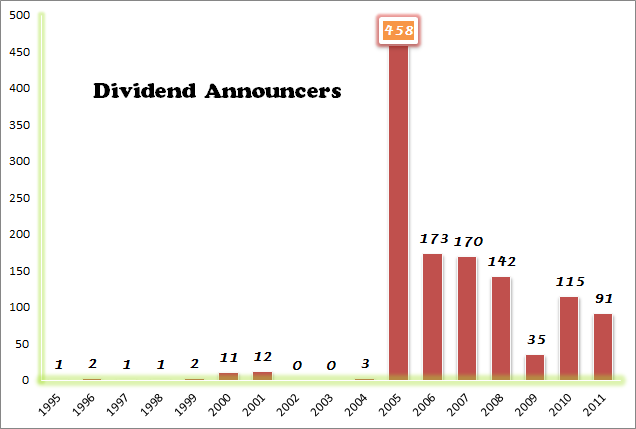
We love dividends at StockViz. In fact, if dividend were to be a girl (or a boy), we would’ve sent her a box of chocolates today. We are constantly on the lookout for new companies that announce dividends. There have been none so far this year, but here’s a handy chart to give you an idea of the number new dividend announcers by year

image

When a company announces dividends, we take it as a sign of confidence from management that it can fund its growth through internal cashflows and has some left over to pay out as dividends.

You can use our screener to hunt for these gems and more!

Making P/E work for you

common (image) aspect ratio found in video and...

Image via Wikipedia

The general rule with Price-Earnings ratios (P/E) is that the lower a stock’s p/e, the better. And a P/E of less than, say, 10, represents excellent value. A low P/E implies more profit for every dollar you invest. However, P/E is only the starting point in researching stocks. Here are some gotchas that you should be aware of:

  1. One-time gains can artificially inflate a company’s P/E: When a company sells assets, it enjoys a one-time bump in earnings that might make the P/E ratio artificially low. And similarly when there are one-time write-offs, P/Es get high. In either of the two cases, P/E is not a gauge of the company’s true ongoing operating earnings.
  2. A low P/E can be a danger sign: Low P/Es may come about because well-informed investors are selling the stock and pushing the price down, regardless of earnings. In other words, unusually low p/e’s can be a sign of danger rather than a clue to a bargain. For example, the 2.73 PE of Aarvee Denims
  3. Don’t ignore stocks with high P/E: Growth stocks have naturally high P/Es. You should expect to pay more for companies with long-term earnings potential. However, stocks with high P/Es tend to be more vulnerable during periods of broad market setbacks. For example, the nearly 205 PE of Adani Enterprises that has a 50-day volatility close to 80%.

Happy investing!

ETFs are extremely profitable…

… for the banks that make them.

Synthetic ETFs may actually be the most profitable type of fund around, generating an average gross profit margin of 69% for their issuers, compared to physically replicated ETFs, that generate an average gross profit margin of 64%. Much of these profits are delivered via ancillary activities like securities lending, securities finance and swaps. The money is being made elsewhere. Outside of the view of ETF clients. Clients are in fact unwittingly providing capital for banks’ ancillary (and risky) ETF-related activities — while, incidentally, being directly connected to the risks that are being generated.

Read more here: http://ftalphaville.ft.com/blog/2011/07/11/617516/if-you-pay-peanuts-for-etfs-you-get/

and here: http://www.indexuniverse.eu/europe/opinion-and-analysis/7904-etf-providers-earn-double-funds-management-fees-says-deutsche-bank.html?Itemid=126

5 Measures to Ignore

The New York Times of November 10, 1919, repor...

Image via Wikipedia

Previously, we had discussed what to look for while buying stocks. Irrespective of whether you are fundamental or technical investor, there are some key metrics that you should follow to screen stocks. However, even though some metrics have complicated math, they can be completely misleading when it comes to their predictive power. 

Measures like Beta, Analyst Recommendations, P/E and PEG typically have very little bearing to how the stock eventually performs. To read more about the 5 measures to ignore while screening stocks, hop on over to Smart Money here.

Enhanced by Zemanta

Why Charts?

“Technical Analysis, which refers to the study of the action of the market itself as opposed to Fundamental Analysis, which studies the goods in which the market deals. We, as technicians, focus our attention on price because that’s the only thing that’s going to pays us, nothing else.”

“Fundamental guys study the cause of market movements; we choose to focus on the effect. All known facts, estimates, surmises, and the hopes and fears of all interested parties are integrated in this effect (price). The Fundamentalist always has to know why, but why doesn’t pay us.”

Must read: Why Charts? | The Reformed Broker.

Dollar Cost Averaging or Systematic Investment Plan

Graph showing the rate of a $1000 initial inve...

Image via Wikipedia

While discussing the buy & hold fundamental investing strategy, I had indicated that the a constant, fixed investment into a broad-based ETF would perhaps be the best way for new investors to build a diversified portfolio. The NIFTYBEES is perhaps the oldest ETF listed in the NSE: it has been tracking the Nifty 50 index since 2002.

How does a do-it-yourself SIP work? Well, its pretty simple actually. You just set aside a fixed amount every month (say, Rs. 10,000) and buy the same stock or ETF every time. To give you an example, say you started buying the NIFTYBEES on the first day of every month, since the time it was listed in 2002, it would look something like this:

image

As you can see, the lower the price, the more units you will actually buy and hence the name Dollar Cost Averaging: you are averaging your buying price of the unit over a period of time.

Now say you did this irrespective of whether the market was down or up, how much would you have gained till date? My calculations show that an SIP on the NIFTYBEES would have netted an IRR of 18%. That’s not bad at all! For the those who want to have a look at the actual cashflow and returns, they can hop over to the spreadsheet on Google Docs.

Happy Investing!

Enhanced by Zemanta

The best place for cash is in my pocket

LET US ALL APPLY FOR OUR SHARE OF THE STIMULUS...

Image by roberthuffstutter via Flickr

The purpose of any business is, at the end of the day, to make money. It could be through providing a service, selling a product, acting as an intermediary or investing in other companies. All of these activities should lead to free cash-flow being generated. At some point, companies have to decide what to do with the excess cash.

image

What should Infosys do with Rs. 2,42,14,00,00,000 ($5.38 Billion) in cash?

Acquisitions

Infosys could try and grow bigger by acquiring smaller companies. However, IT services is a cashflow business; a bigger company will end up stock-piling more cash. For example OFSS (Oracle Financial Services) has more than $1B in cash.

Alternatively, it could buy or fund IT product companies. However, that would mean that Infosys knows more about running or funding IT product companies than the stock holder. Also, what if stock holders don’t want to invest in product companies at all?

Stock buy-backs

Infosys could also buy back its stock. Companies that pay their employees in stock options typically need to buy back their stock to avoid dilution. Infosys’ cash hoard can buy back nearly 25% of its public float and investors benefit from the capital appreciation (higher stock price) that the move would entail. The capital appreciation would result in a tax event for the investor as well.

However, what would Infosys do with all the stock it now owns? It could use it as currency to acquire other companies (pay in equity rather than cash). Or it could start paying out stock options to its employees, etc.

Dividends

Infosys could choose a third, more simpler alternative: distribute the cash as dividends. Dividends are perhaps the most straight-forward, investor friendly way to return cash to the stock holder. It allow the investor maximum flexibility in deciding what to do with the cash. And since dividends are actual checks that need to get sent out, it means that the accounting profits are actually real profits. In September, Infosys paid out Rs. 40 per share, that is close to $339 million to its public shareholders.

I personally prefer dividends to other forms of returning cash to the stock holder. Its simple, it doesn’t expect the management to work miracles trying to diversify and its cash in the pocket.

Enhanced by Zemanta

Value Traps

A Week in Singapore 3

Image by Ronald HN Tan via Flickr

One of the fundamental strategies we had discussed before was value investing. While looking for value plays, it is important to understand the stage at which the rest of the market is with regard to the specific stock. While you may recognize value in a stock (value opportunity) and decide to invest in it, it might take a while for the market to recognize value and bid up its stock price (value in action). Sometimes, you may just be too early and get trapped in a long position while the rest of the market continues to hammer the stock price down, a la, value trap.

INFOSYSTECH

For example, let us take a look at Infosys. Given its strong cash position, professional management and brand, a typical value investor could be easily drawn to the stock. However, investing at any point since the beginning of this year would’ve trapped the investor in a dog stock, with every single pop turning out to be an opportunity for the market to sell.

To take another example, this time of Cisco.

CSCO

There is no doubt that there is a good value opportunity. It has a ton of overseas profits, it is paying out dividends and buying back its stock, it is a market leader in most of its product categories and has an M&A track-record like you hear about. However, the market has yet to recognize it and just like Infosys, buying the stock at any point since the beginning of the year would’ve been a trap.

As the John Maynard Keynes once said, the markets can be irrational longer than you can remain solvent. Value investors will do good to heed that advise.

Enhanced by Zemanta